Introduction
At the beginning of February, I joined a new innovation team at SYMCA (the South Yorkshire Mayoral Combined Authority). Our remit includes exploring two major innovation challenges: one in early years education, focused on improving early literacy, and another centred on improving public transport—particularly the bus system. Alongside these, we also have a wider ambition to embed a culture of innovation across South Yorkshire.
Since starting in the role, I’ve been reflecting on what innovation means to me personally, and how we—as a team—might articulate an innovation approach we can all align behind. Having a shared understanding of the kind of innovation we want to promote will be essential if we are to succeed.
As part of this sense‑making process, I’m writing a series of blog posts. These are intended to spark conversation rather than present anything fully formed. I’ll also be sharing posts linked to each challenge area. Unsurprisingly, developing partnerships and working collaboratively will be essential for us to achieve success in any of these areas
A Shared Foundation for Innovation
So far, our discussions have centred less on defining innovation in the abstract and more on the practical question of how we enable it. Even so, some common themes regularly appear in the way innovation is described:
- creating new value through the practical application of ideas
- a structured, exploratory process for learning, testing, and refining
- a mindset grounded in curiosity, generosity, and evidence
My own reflections draws on systems thinking, design thinking, behavioural insights, social innovation, and some of the creative practices I’ve brought with me from earlier work in the arts. Through conversations within the team, social innovation and behavioural insights have become stronger influences on how I’m thinking about our collective innovation process.
Start with the Problem, Not with the Solution
Something the whole team seems aligned on is the need to start with the problem—not with technologies searching for a problem. This principle runs throughout much of today’s innovation literature, from public‑sector design to systems change and social innovation.
It also echoes a key finding from my PhD research: smart cities should start with the city, not with the “smart.”
In practical terms, this means that while we may indeed explore technologies such as AI if they appear helpful, they should never be the starting point. The starting point should always be the challenge itself and the specific needs of South Yorkshire.
One possible area of tension here is the risk that starting with the problem may appear to reflect the deficit model. Alternative approaches including asset-based community development and appreciative inquiry challenge that approach by emphasising the strengths that exist within systems or communities. However, we don’t really think that consideration of these approaches needs to contradict the principle that its helpful to understanding context before thinking about solution. Appreciating strengths can sit comfortably alongside gaining a deep understanding of the problem space.
Within this area my thinking is influenced by
· Einstein allegedly stating that if he had 1 hour to save the world he’d spend 55 minutes understanding the problem and 5 minutes finding the solution
· Don Norman (a key thinker in design thinking) stating that he never solved the problems his clients asked him to solve. The key point here is he was really emphasising the importance of research, suggesting that by conducting research the real problem is likely to be quite different to the problem you started with.
Innovation and Design Thinking
Our interactions with Nesta and The Behavioural Insights Team included being introduced to The Public Path to Innovation, which outlines a four‑stage approach based on ten years of innovation work in cities around the world:
- Aim: Set the mission
- Design: Reimagine solutions
- Activate: Deliver initiatives
- Sustain: Embed change
This approach aligns closely with the design thinking process, as illustrated in the diagram below shared by Paul Bailey at the February 2026 NUX Sheffield event :
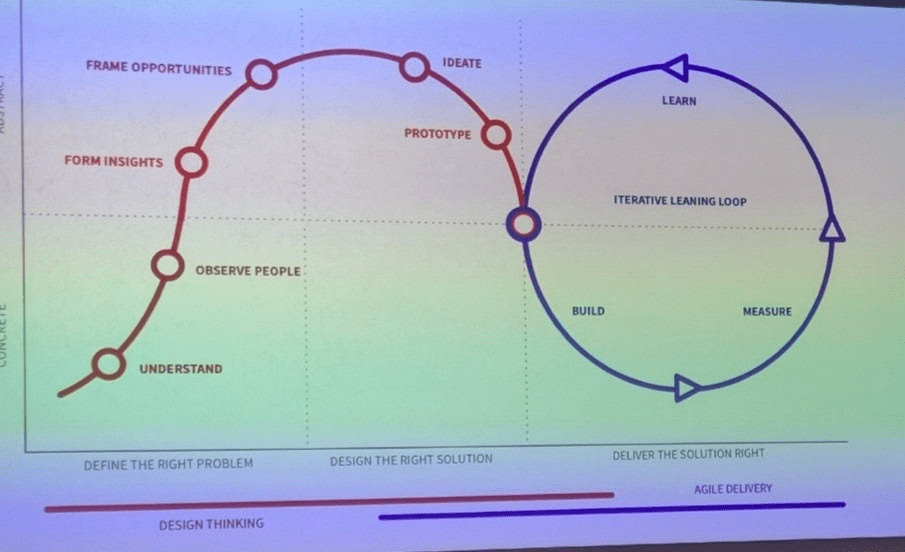
The overlap isn’t surprising. The playbook explicitly references design thinking concepts such as framing the problem, synthesis, ideation, and prototyping. These are all familiar parts of my own practice from years spent working as a user researcher in UK government design teams.
I also found the ideation principles in the playbook reassuringly familiar:
- letting go of constraints
- deferring judgement
- prioritising quantity over quality
- collaborating openly
These have all long been core principles in effective design.
Innovation and Behavioural Insights
A recent COM‑B training session reinforced the strong alignment between behavioural insights and user‑centred design. Discussions about personas, behavioural drivers, friction points and targeted interventions all echoed methods I’ve used as a design researcher. This makes sense: both approaches seek to understand what people actually do and why.
Shared principles between behavioural insights and user‑centred design include:
- observing and understanding real users
- analysing behavioural patterns
- designing interventions that reduce friction and improve experience
As outlined in learncuriously.wordpres…, there are however also differences. Some of these include
- UX often focuses on usability and interaction within a specific product or service; behavioural insights is broader, focusing on understanding and influencing behaviour across a wider context
- BI draws more deeply on decades of psychological research
- both use prototypes, but the messages or hypotheses being tested often differ
Conclusion
There are different ways to think about enabling innovation. Two of these are design thinking and behavioural insights. Whilst there is a lot of connections between the two each brings a slightly different focus. Which becomes most relevant is likely to be determined to some extent to the nature of the specific focus we engage with within our challenge areas.
Some principles, however, will remain constant: start by understanding the problem, not by searching for a place to land a pre‑chosen solution.
In future posts, I’ll bring in reflections from systems thinking, social innovation, and the arts, and how each of these might support our innovation practice.
If you have thoughts, reflections, or challenges to any of the ideas here, I’d love to hear from you. As noted at the start, these posts are intended as conversation starters, rather than to communicate definitive positions.
This blog was originally posted on Substack on Friday 20th March 2026 – link to original posting – https://substack.com/@timwoolliscroft/note/c-230747604?r=7yjl51&utm_source=notes-share-action&utm_medium=web
 Digital Tim